Quality Assurance vs Quality Control: What’s the Difference?


A newly launched app crashing repeatedly or a device failing unexpectedly can quickly frustrate customers and damage trust.
Even a small quality issue can negatively impact customer experience and brand reputation.
Customers expect products and services to work perfectly from the start. That is why companies make significant investments in quality management.
However, there is still a lot of confusion between Quality Assurance (QA) and Quality Control (QC).
Although they share the same goal of providing high-quality products, they are not the same thing. QA focuses on preventing errors, whereas QC identifies and fixes them before products reach customers.
Knowing the difference between QA and QC can help companies improve productivity, eliminate costly mistakes, and create better customer experiences.
In this blog, you will explore what is quality assurance, how it differs from quality control, and why both are essential for long-term business success.
What Is Quality Assurance (QA)?
Quality assurance (QA) is a proactive approach to quality management that aims to prevent errors before they occur. QA isn’t just about looking at the finished product, it’s about enhancing procedures, workflows, and quality criteria to provide consistent outcomes.
Quality assurance in software development includes process reviews, compliance checks, risk tests, and practices of continuous improvement.
QA teams help streamline workflows, reduce errors, and maintain consistent product quality across projects and teams.
What Is Quality Control (QC)?
Quality control (QC) is the process of finding and correcting problems in a product before it’s sent out to customers. Quality control tests, inspects, and reviews the finished product, whereas quality assurance focuses on process improvement. In software development, QC includes bug testing, inspections, and error reporting before product release.
This quality management process allows companies to maintain product quality and meet defined quality standards. It also reduces errors and ensures that customers receive reliable, proven products or services.
Quality Assurance vs Quality Control: Major Differences
Although QA and QC are related, their roles are very different. Let us make sure we understand the major differences. The table below highlights the key differences between QA & QC.
| Aspects | Quality Assurance (QA) | Quality Control (QC) |
| Goals and focus | Prevents defects by improving workflows, processes, and quality standards before they arise during development. | Detects flaws in products through testing and inspections before they reach customers or final deployment stages. |
| Approach and execution | Follows proactive quality management practices throughout development to reduce risks and improve process performance. | Uses reactive testing methods after development to detect defects and verify final product quality standards. |
| Development Timing | Activities begin during the planning stages to establish quality processes and avoid future development issues. | Following the completion of development, activities begin to inspect products and identify defects prior to customer delivery. |
| Team responsibilities | Teams are constantly improving workflows, ensuring compliance standards, and promoting continuous process improvement from project to project. | Teams conduct inspections, bug testing, and product reviews to validate quality before product release. |
| Tools and methods | Audits, ISO standards, documentation reviews, and process enhancement methods are used to maintain workflow quality. | Uses testing, inspections, and defect tracking systems to find errors and improve product reliability. |
| Business impact | Reduces business costs by avoiding defects, increasing productivity, and reducing rework during the development process. | Protects brand reputation by ensuring that reliable products reach customers via proper testing and quality inspections. |
Why Businesses Need Both QA and QC
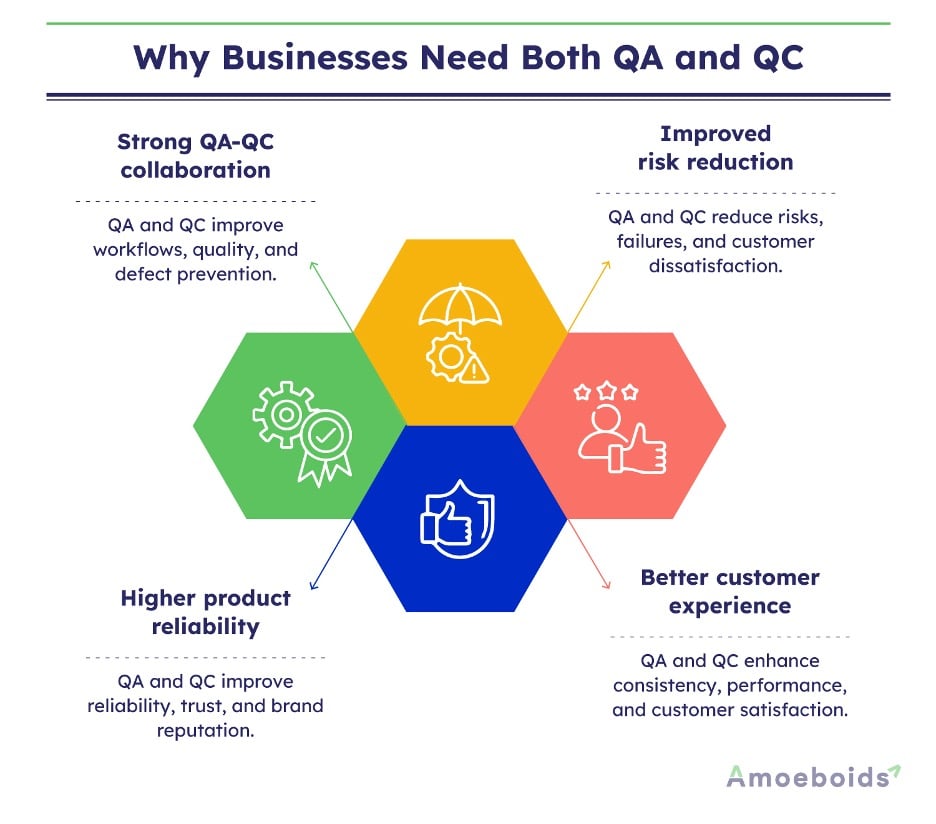
Some companies mistakenly only focus on testing products and not enhancing workflows. Some only rely on process documentation and do not do testing. The truth is that companies require both QA and QC to deliver quality consistently.
- Strong QA-QC collaboration: QA builds strong workflows to avoid defects during development. QC evaluates and inspects final products to ensure consistent quality before they are delivered to customers.
- Improved risk reduction: QA reduces risks by enhancing workflows and avoiding process failures early. QC detects any remaining issues before release, allowing companies to avoid financial losses and customer frustration.
- Better customer experience: QA improves product consistency by implementing more effective quality management practices. QC ensures that products meet customer expectations by identifying bugs, errors, and performance issues before they are released.
- Higher product reliability: QA and QC work together to help businesses consistently deliver reliable, high-quality products. It will enhance customer confidence, boost brand image, and create long-term customer loyalty.
Best Practices for Implementing QA and QC Successfully
Just having QA and QC teams isn’t enough. Companies need to apply them strategically to get the best outcomes. Here are some best practices to improve quality management and achieve better results.
- Clear quality standards: Teams should establish clear quality standards at the beginning of the project. Everyone should be aware of the expected results, workflows, and approval criteria. It helps reduce confusion and allows for consistent work across teams.
- Effective testing automation: Testing automation allows teams to save time and identify issues more quickly. Automated testing tools save time and enhance reliability. Software teams can use automated regression testing to keep their products stable during frequent updates.
- Continuous quality tracking: Quality management must continue throughout the entire project life cycle, not just during final testing. Teams must regularly review defects, performance metrics, and process improvements. Continuous tracking helps to identify recurring problems and improve overall efficiency.
- Regular customer feedback: Customer feedback is a great way to get real user experience and expectations. There are things that internal teams can miss in testing that customers can often spot. Regular customer feedback allows companies to effectively improve their QA techniques and QC activities.
Conclusion
Quality is no longer optional in today’s competitive market. Customers expect reliable, consistent, and user-friendly products every time.
Understanding quality assurance allows companies to avoid defects, whereas quality control ensures that products meet expected standards before delivery.
QA and QC collectively improve customer satisfaction, reduce risks, and increase the trustworthiness of products.
Companies that implement both QA and QC can improve performance, strengthen customer trust, and achieve long-term success.
So, start improving your QA and QC strategies right away to provide better experiences and stay ahead in a competitive market.